

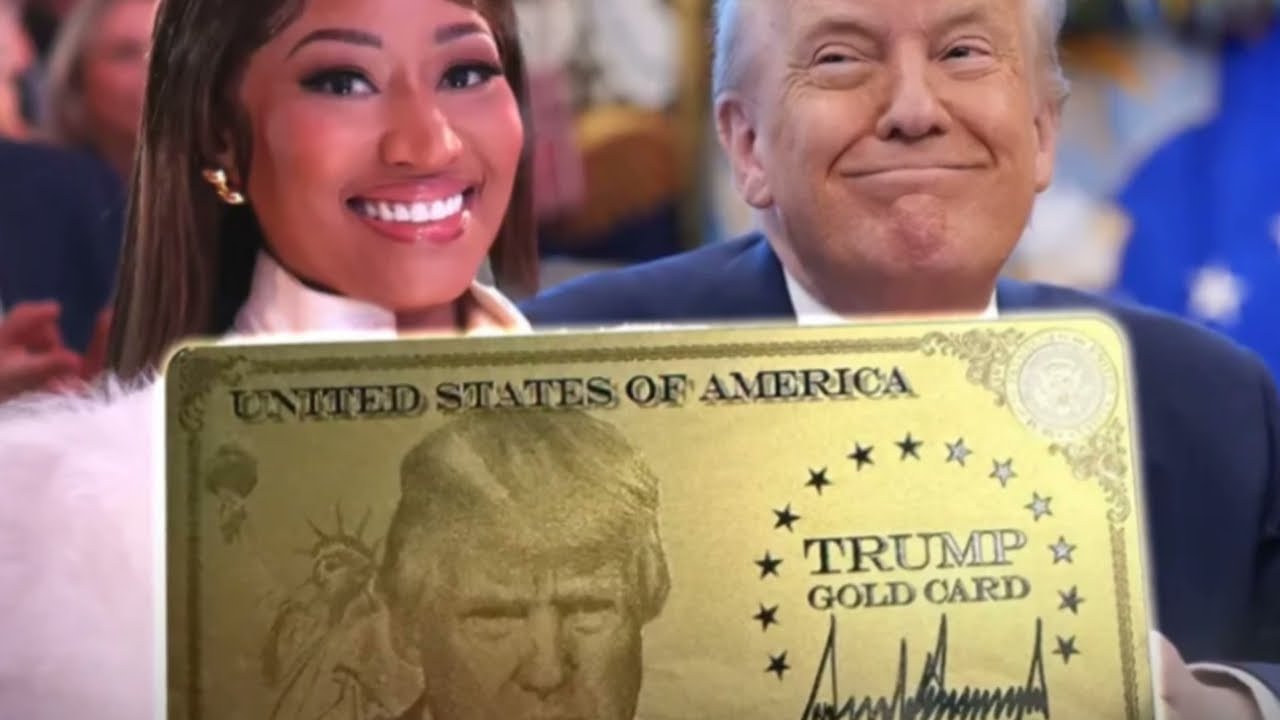
When Nicki Minaj posted a shiny gold card featuring Donald Trump’s face and suggested it was helping her finalize U.S. citizenship paperwork, the internet did not simply react, it unraveled. What looked like a casual flex quickly spiraled into a political, legal, and cultural debate that had people dissecting motives, immigration law, and celebrity influence all at once. But this moment did not come out of nowhere. It was the culmination of a series of deliberate public moves that had already raised questions long before the card ever appeared.
The first major shift happened when Nicki publicly defended Donald Trump after he posted claims suggesting that white Christians in Africa were being killed. That statement triggered immediate backlash and widespread fact checking, but Nicki’s decision to step in and defend him is what truly shocked many longtime fans. It was not vague, neutral, or accidental. For people who had followed her career for decades, this marked a sharp and unexpected pivot, and almost immediately the same question began circulating everywhere. What is her angle.
That question intensified when Nicki later appeared alongside Erika Kirk, a figure closely associated with pro Trump political commentary. This was not treated as a casual appearance or a random conversation. It felt intentional, curated, and symbolic. At that point, many stopped viewing Nicki’s statements as isolated opinions and began reading them as part of a broader pattern of political signaling. The Erika Kirk appearance became the moment speculation shifted from curiosity to scrutiny.
Twice that night, Nicki put her foot in her mouth. The first time came when she stated, “For boys, boys be boys. There’s nothing wrong with being a boy. How about that. How powerful is that. How profound is that. Boys will be boys, and there’s nothing wrong with that.” Taking into consideration that Nicki’s fanbase is predominantly made up of young gay individuals, the comment did not land well at all. Instead of sounding affirming, it came across as tone deaf and disconnected from the lived realities of a community that has long been central to her success and cultural relevance.
She then went on to escalate the moment further when she said, “Dear young men, you have amazing role models like our handsome, dashing president. And you have amazing role models like the assassin JD Vance, our vice president. And when I say that, trust me, there’s nothing new under the sun that I have not heard, so you’re fine.”
The line immediately set social media on fire. The use of the word “assassin” stunned viewers, even as it was clear Nicki was attempting to preemptively deflect anticipated criticism by signaling that she had already heard every insult and accusation imaginable. Still, the phrasing landed awkwardly and uncomfortably, and the backlash was swift.
What made the moment even more jarring was the timing. Nicki appeared to quickly recognize the weight of that word choice, particularly given that Erika Kirk’s husband, Charlie Kirk, had been assassinated just a few months earlier. In that context, the word “assassin” was no longer rhetorical or abstract, it was painfully literal. The heightened sensitivity surrounding political violence at the time made the remark feel careless rather than provocative, and what may have been intended as sarcasm or bravado instead read as an avoidable misstep.
Rather than reinforcing her message, the comment redirected attention onto her judgment. The discomfort was visible, the reaction immediate, and the moment became emblematic of a broader issue, a celebrity stepping into political language without fully accounting for the real world consequences those words now carry.
Speculation exploded almost instantly. Timelines filled with theories, none of them flattering. Was this about influence. Was it about aligning herself with power. Was it about shielding her husband from continued scrutiny related to the sex offender registry. Was it about her brother’s prison sentence. Was it about leverage, protection, or access. No one had proof, but the sheer volume of speculation reflected how confusing and calculated the behavior appeared.
What made the entire situation even more baffling is that none of this was legally necessary.
Nicki Minaj is already a legal green card holder. She has lived in the United States for over 35 years, paid taxes, built businesses, and contributed economically and culturally on a massive scale. Under U.S. immigration law, that alone makes her eligible to apply for citizenship. No political endorsements are required. No public loyalty displays matter. No alignment performances factor into the process. All she would have had to do is apply.
Then came the Gold Card.
After attending a Trump affiliated political event, Nicki posted a photo of the gold colored card and implied she was “finalizing” her citizenship paperwork. That single sentence detonated online. Fans assumed it was some kind of expedited immigration benefit. Critics accused her of trying to game the system. Others genuinely wondered if a new immigration pathway had quietly been introduced for wealthy or famous supporters.
The confusion grew loud enough that the White House stepped in to shut it down.
A White House official clarified that the so called Trump Gold Card was “a souvenir,” stressing that it was “not a visa document” and carried “no legal value.” The official also noted that Nicki Minaj had been a lawful permanent resident for roughly 20 years and that the card would “serve little value” in any immigration process. In plain terms, it looked official but meant nothing.
At that point, the mystery technically had an answer, but the explanation made the entire saga look worse, not better.
Even now that we understand why she leaned into the Trump narrative, the logic still does not hold. Citizenship was already available to her through the normal legal process. There was no urgency, no barrier, and no justification for public political signaling. The Gold Card did not unlock anything she did not already qualify for.
In the end, the Gold Card joins a long list of moments where celebrity, politics, and social media collided and left the public confused. The difference here is that once the explanation arrived, it exposed how needless the spectacle truly was.
Immigration law does not change through Instagram captions. Citizenship is not granted through souvenirs. And when someone already qualifies, performing politics instead of filing paperwork is not strategy.
It is just noise.
