
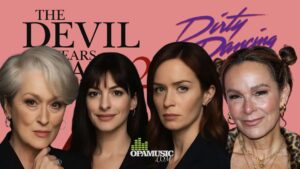





Hollywood’s current obsession with sequels has produced two announcements that, on the surface, feel similar but could not be more different in spirit. A new Dirty Dancing film is officially in development, while The Devil Wears Prada is also set to return to theaters in 2026. Both rely heavily on nostalgia, yet only one of them feels like it has a legitimate reason to exist.


It has been 38 years since Dirty Dancing first hit theaters and 16 years since Patrick Swayze died of pancreatic cancer. Lionsgate’s decision to move forward with a sequel, featuring Jennifer Grey reprising her role as Frances “Baby” Houseman and serving as an executive producer, sounds respectful in theory. The film is expected to return to Kellerman’s resort and build on the legacy of the original. In reality, it raises more concern than excitement.
The original Dirty Dancing was lightning in a bottle. Set in the summer of 1963, it told a coming-of-age love story that quietly challenged class divisions and social expectations, anchored by an iconic soundtrack and a final dance that remains one of the most emotionally satisfying endings in film history. But the heart of that film was Johnny Castle. Swayze’s performance gave the story its gravity, vulnerability, and heat. While Baby was the narrative center, Johnny was the emotional engine. Without him, the idea of revisiting this world feels less like continuation and more like imitation.
Adding to that discomfort is the reality that many members of the original cast have passed away. Their absence underscores an uncomfortable truth. Dirty Dancing belongs to a specific cultural moment that cannot be recreated. It did not need expansion. It needed preservation. A sequel risks diluting a classic that knew exactly when to end. Some stories really are meant to stop at the lift.
On the other hand, The Devil Wears Prada presents a very different case. Nearly 20 years after its release, the film feels sharper and more relevant than ever. Its exploration of ambition, power, and personal compromise still resonates in today’s work culture, perhaps even more so in an era shaped by social media, digital journalism, and influencer economies.
Practically speaking, a sequel makes sense. The principal cast is alive and expected to return, and the original screenwriter’s involvement suggests continuity of tone and intelligence rather than a hollow cash grab. More importantly, the original film left its characters at crossroads, not conclusions. Andy walked away, but the industry remained intact. Miranda retained her power, but not without cost. Emily survived, but changed. Those unresolved tensions offer fertile ground for exploration.
Unlike Dirty Dancing, The Devil Wears Prada does not risk undoing a perfect ending. It has room to grow if it is willing to interrogate aging, relevance, ambition, and control in a world that no longer operates by the same rules. The danger is not that it will exist, but that it will play it safe.
In the end, these two sequels highlight the real issue with Hollywood nostalgia. It is not about revisiting the past, it is about understanding why a story mattered in the first place. One film feels complete and untouchable. The other feels unfinished in ways that still matter. And that difference makes all the difference.


