






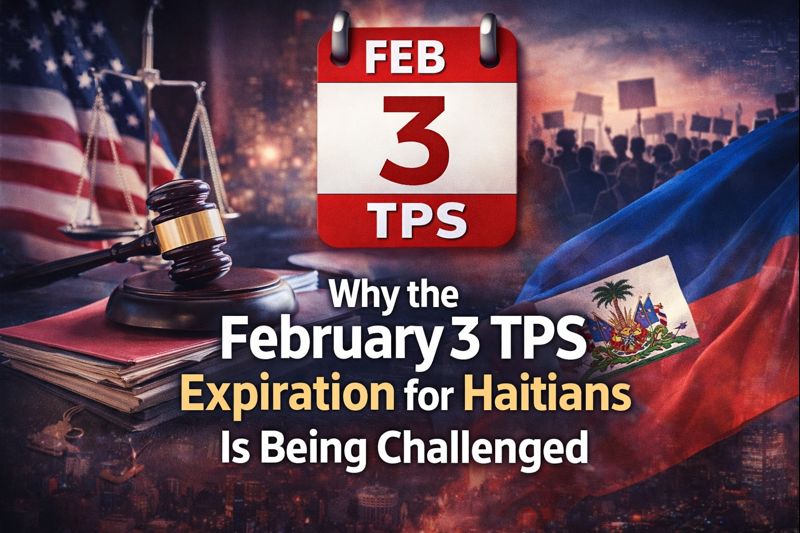
The February 3, 2026 expiration date tied to Temporary Protected Status for Haitians has caused understandable concern, confusion, and fear across immigrant communities. On paper, the date looks final. In practice, it is anything but settled. What is happening now is a familiar legal and political standoff, one that has played out before with other TPS designations, and one that rarely ends exactly the way early deadlines suggest.
TPS is not a universal program with a single expiration date. It is country specific and entirely dependent on conditions in the designated country as well as decisions made by the executive branch of the United States government. For Haiti, the current designation runs through February 3, 2026 unless it is extended, paused by court order, or replaced by new policy. That last part matters because deadlines tied to TPS are often disrupted by litigation, injunctions, or last minute administrative action.
At the center of the current effort to block or delay the February 3 date are federal lawsuits challenging the government’s attempt to allow Haiti’s TPS designation to expire. These cases argue that the decision to end protections is arbitrary, ignores overwhelming evidence of deteriorating conditions in Haiti, and fails to follow proper legal procedures required under immigration law. Similar arguments have succeeded in the past, not only for Haiti but for TPS holders from other countries as well.
Courts have historically been willing to intervene when TPS terminations appear rushed, politically motivated, or disconnected from reality on the ground. Judges do not grant TPS themselves, but they do have the power to stop the government from ending it while a case is being litigated. That distinction is crucial. A court order does not create permanent protection, but it can prevent thousands of people from losing legal status and work authorization while legal challenges move forward. In many cases, that pause becomes the practical outcome for years.
Beyond the courts, Congress is also part of the equation. Members of the House and Senate have introduced legislation and procedural maneuvers aimed at forcing votes on extending TPS for Haiti. While Congress has a long history of gridlock on immigration, TPS extensions tied to humanitarian crises have occasionally broken through, especially when economic impact and workforce disruption become part of the discussion. Haitian TPS holders are deeply embedded in healthcare, construction, transportation, education, and caregiving sectors across the United States. Ending protections abruptly would not only affect families but entire local economies.
Advocacy organizations, faith leaders, and state and local officials are applying sustained pressure as well. This matters more than people often realize. TPS decisions are discretionary, which means public pressure and political cost are real factors. Administrations may signal toughness early, only to reverse course quietly later through extensions or redesignations when the consequences become unavoidable.
So what are the chances that efforts to block the February 3 deadline succeed. Realistically, they are stronger than average. On a scale of one to ten, the likelihood of at least a delay or injunction sits around a seven. That does not guarantee a long term extension, and it does not mean uncertainty disappears. It does mean that a sudden, clean cutoff on February 3 is unlikely.
The most probable outcome is not permanence but interruption. A court order delaying termination. A temporary extension announced closer to the deadline. A legal limbo that preserves work authorization while cases proceed. This is not ideal, but it is consistent with how TPS fights have unfolded repeatedly over the past decade.
What is least likely is the worst case scenario many fear, a full termination on February 3 with no relief, no court action, and no administrative response. That outcome would require silence from the courts, inaction from Congress, and indifference from an administration facing mounting legal and political pressure. History suggests that combination is rare.
For TPS holders and their families, the takeaway is this. The date matters, but it is not destiny. Preparation is important, panic is not. Legal challenges are active, political efforts are ongoing, and the situation remains fluid. TPS has always existed in a space between law and discretion, and that is exactly where the current fight is playing out.
The February 3 deadline may be real on paper, but whether it survives contact with the courts and political reality is very much an open question.


